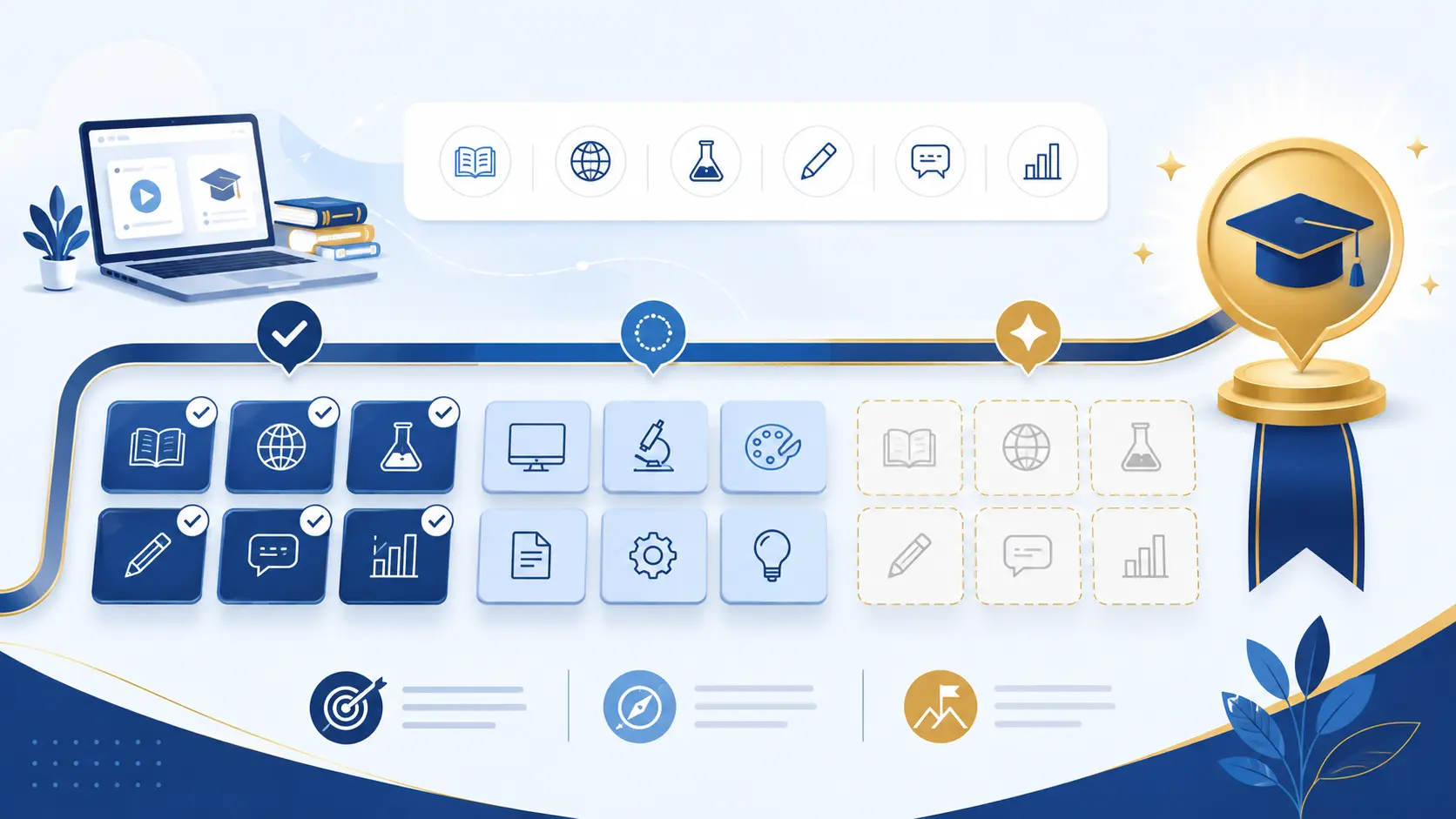
Inquiry and admissions call
Families submit an inquiry, receive next-step communication, and can book an admissions call through RCA International scheduling.
 Riviera Christian Academy InternationalRCA InternationalOnline admissions
Riviera Christian Academy International
RCA International helps families understand transfer records, graduation planning, tuition options, and the next step toward an online high school program.
Families submit an inquiry, receive next-step communication, and can book an admissions call through RCA International scheduling.
Staff review prior academic records, then prepare a graduation plan based on the student's remaining requirements. High school graduation requires 24 credits.
Applicants review the plan, complete the full application, and receive an RCA International admissions decision after staff review.
Families can ask about selected standard courses through RCA International when a student does not need a 6-course full-time semester plan; admissions confirms fit, pricing, and how the course applies.
Tutoring may be available for individual and family enrollment paths when the student needs additional academic support.
Tell RCA International who the student is and what program path you are exploring.
Choose an available admissions call time through the RCA International scheduler.
Upload requested academic records through the secure portal after staff requests them.
Review the education plan and submit the full application for staff decision.
Accreditation
RCA International provides an accredited online school pathway with admissions review, records review, and graduation planning handled through the school.
Tuition aid
Tuition aid may be available for families who desire to have their children at Riviera Christian School but require financial assistance. Applications can be accepted after students are registered for the upcoming year.
Tuition aid is for U.S. families only.
Course offerings
RCA International course options include required core categories, elective pathways, and eligible Corban University dual-credit options.
Admissions can help match the student to the right level of enrollment before application.
RCA International handles the student's online high school pathway and graduation planning for 6 courses per semester.
Students may take more than 6 courses per semester; additional courses are charged at the individual course rate.
Families can ask about selected standard high school courses through RCA International without enrolling full time; admissions confirms fit, pricing, and how the course applies to the student's plan.
Staff can review prior coursework and identify remaining requirements before the application is finalized.
High school graduation requires 24 credits; core courses are organized by the main graduation-planning categories.
Higher Education and Career Path Skills prepares Oregon high school students to advocate for themselves, compare future pathways, navigate applications and funding, and enter the workforce with practical evidence of readiness. Students practice self-advocacy, compare education and career options, and prepare applications and workplace communication.
Foundations of Wellness A helps high school students build practical health literacy through wellness, prevention, public health, safety, nutrition, mental health, substance-use prevention, resource evaluation, decision-making, communication, goal setting, and advocacy.
Foundations of Wellness B continues high school health literacy through overdose prevention, mental health, communication, boundaries, violence prevention, body image, healthcare and resource navigation, wellness planning, support systems, health equity, and advocacy.
Genre Studies A helps students understand how genre expectations shape short fiction, poetry, drama, nonfiction, adaptation, argument, and historical documents. Students build grade-level reading stamina and flexible analysis skills through public-domain or owner-approved texts, discussion, and evidence-based responses.
Genre Studies B extends genre analysis into argument, historical nonfiction, media, research, genre blending, and comparative capstone work. Students apply reading, writing, revision, and presentation skills to real-world and creative genre tasks.
American Literature A surveys early American voices, foundational documents, Romanticism, Gothic literature, poetry, realism, modernism, and Harlem Renaissance writing. Students build reading stamina, literary analysis, rhetorical analysis, discussion, and evidence-based writing through public-domain or owner-approved American texts.
American Literature B extends modernism, Harlem Renaissance voices, public argument, research, contemporary and multicultural perspectives, and capstone synthesis. Students compare literary periods and documents while strengthening source use, revision, presentation, and evidence-based interpretation.
World Literature A introduces global literary traditions through translated-text awareness, short fiction, poetry, myth, drama, nonfiction, speeches, and documents in conversation. Students build high-school reading stamina and comparative analysis skills using public-domain or owner-approved world texts.
World Literature B extends global literary study through rhetoric, historical documents, media, translation, research, revision, and comparative capstone work. Students synthesize sources across cultures while strengthening evidence, presentation, conventions, and audience awareness.
British Literature A introduces major British literary periods from early foundations through Romantic and Victorian writing. Students analyze language, form, character, rhetoric, historical context, and performance choices while building high-school reading stamina with public-domain or owner-approved texts.
British Literature B continues British and approved Commonwealth literary study through Romantic, Victorian, modern, research, revision, and capstone work. Students synthesize texts across periods and media while strengthening interpretation, explanatory writing, presentation, and conventions.
Algebra I A develops quantitative reasoning, expression structure, one-variable and two-variable linear relationships, functions, systems, radicals, and exponential modeling. Students connect symbolic, graphical, tabular, and contextual representations through practice, assessment, and modeling projects.
Algebra I B extends real-number structure, exponential models, polynomial operations, factoring, quadratic equations, quadratic functions, and data modeling. Students build fluency with equivalent forms, function features, and statistical reasoning through structured practice and projects.
Geometry A develops transformations, congruence, proof, constructions, similarity, proportional reasoning, right-triangle trigonometry, and circle relationships. Students connect diagrams, formal reasoning, measurement, and applications through structured practice and projects.
Geometry B extends geometric reasoning into right-triangle trigonometry, circles, coordinate and analytic geometry, measurement, density modeling, and design constraints. Students use diagrams, formulas, proof, and real-world contexts to strengthen spatial reasoning and precision.
Algebra II A deepens work with expression structure, radicals, complex numbers, polynomial and rational functions, transformations, inverses, systems, and rates of change. Students use multiple representations and mathematical precision to prepare for advanced modeling and analysis.
Algebra II B extends exponential and logarithmic functions, sequences, probability, normal distributions, inference, simulations, and multi-representation modeling. Students apply algebraic and statistical reasoning to interpret models, compare methods, and communicate conclusions.
Pre-Calculus A extends Algebra II and Geometry into advanced function analysis, trigonometry foundations, analytic geometry, and mathematical modeling. Students connect symbolic, graphical, numerical, and contextual representations while preparing for calculus or advanced quantitative pathways.
Pre-Calculus B deepens trigonometric functions, identities, vectors, matrices, sequences, and advanced modeling. Students use precision, technology, and multiple representations to prepare for calculus, statistics, or other advanced quantitative work.
Physical Science A introduces matter properties, atomic structure, periodic patterns, bonding, chemical reactions, energy, motion, forces, and momentum. Students use models, data, investigations, and design challenges to explain physical science phenomena.
Physical Science B extends motion, momentum, energy transfer, fields, electricity, magnetism, waves, electromagnetic radiation, and information technologies. Students apply evidence, models, and engineering reasoning to analyze systems and design solutions.
Life Science A develops high-school understanding of DNA, proteins, specialized cells, homeostasis, cell division, photosynthesis, respiration, heredity, variation, evolution, and natural selection. Students use models, data, and evidence-based explanations to connect molecular, organismal, and population-level processes.
Life Science B extends evolution, adaptation, environmental change, group behavior, population dynamics, biodiversity, matter cycling, energy flow, and ecosystem stability. Students analyze data, construct explanations, and evaluate solutions for biological systems and human impacts.
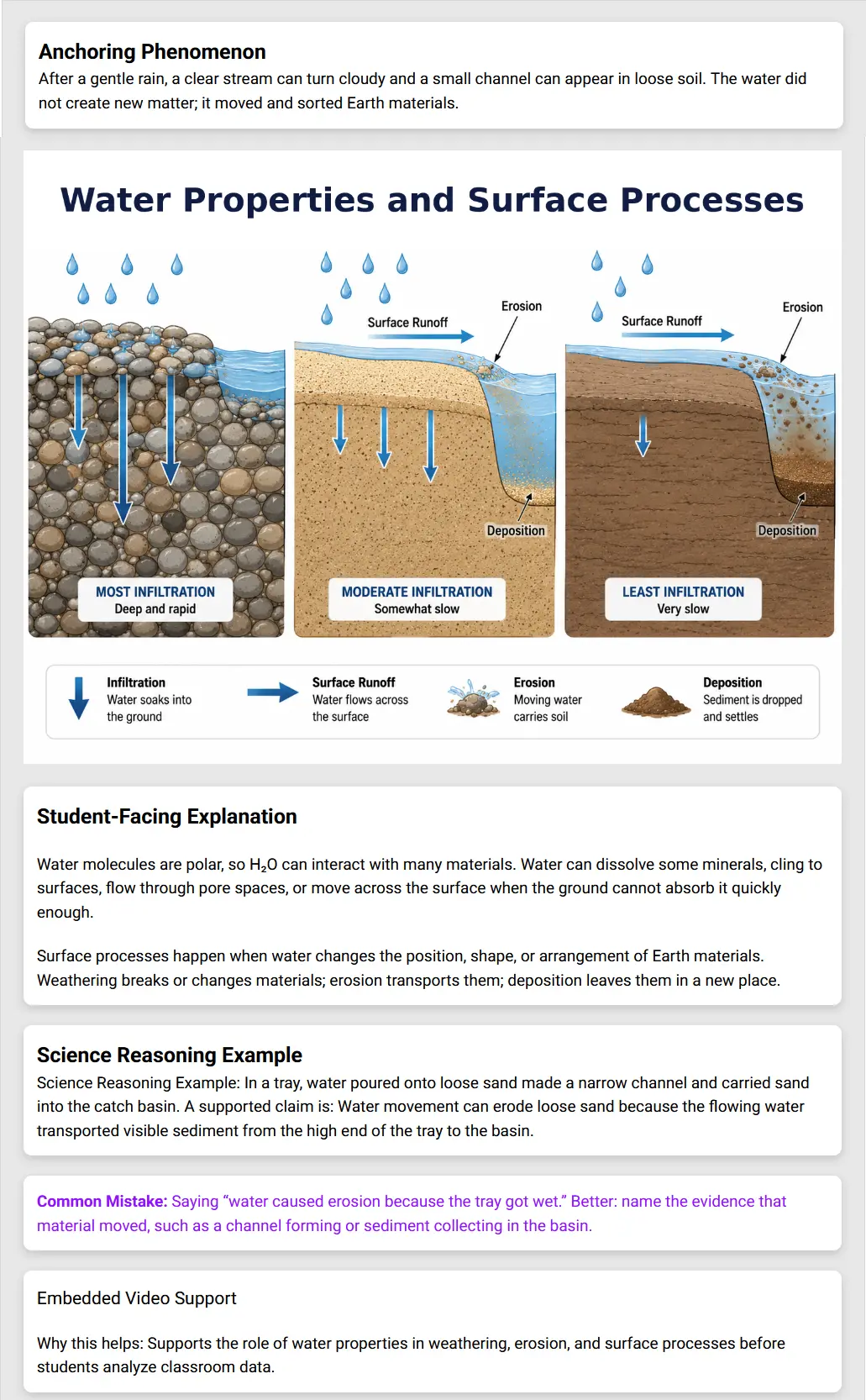
Earth Science A introduces astronomical evidence, solar-system motion, Earth formation, geologic time, plate motion, surface processes, weather, climate, and carbon cycling. Students use models, data, and evidence-based explanations to connect Earth and space systems.
Earth Science B extends Earth-system study into climate data, human impacts, resources, hazards, sustainability, and engineering decisions. Students analyze evidence, compare solutions, and communicate explanations about Earth processes and environmental systems.
Environmental Science A introduces ecosystem interactions, biodiversity, matter and energy cycling, Earth-system feedbacks, water systems, climate, resources, and human impacts. Students analyze data, use models, and evaluate evidence to explain environmental systems and propose constrained solutions.
Environmental Science B extends environmental systems study into sustainability, climate impacts, resource management, environmental justice, solution evaluation, and design tradeoffs. Students use evidence, models, simulations, and data displays to evaluate human impacts and defend practical environmental solutions.
World History (pre-WWI) A is the first term of a chronological Grade 9 world history sequence, from early human societies through selected regional societies before 1500. Students learn actual historical content through public-domain or owner-approved source sets, maps, timelines, artifacts, and evidence-based historical reasoning.
World History (pre-WWI) B is the second term of a chronological Grade 9 world history sequence, from Renaissance-era diffusion through the pre-1914 road to World War I. Students use source documents, maps, timelines, charts, images, and data to build historical explanations.
Modern World History A is the first term of a Grade 10 world history sequence focused on the global twentieth century and its roots after 1914. Students study concrete historical developments through source sets, maps, timelines, images, data, and evidence-based explanations.
Modern World History B is the second term of a Grade 10 world history sequence focused on the postwar, Cold War, decolonization, globalization, and contemporary world. Students use source documents, maps, timelines, charts, images, and data to build historical explanations.
US History A is the first term of a Grade 11 United States history sequence focused on the development of the United States through source-based historical inquiry. Students use documents, maps, timelines, images, data, and evidence-based explanations to study change, conflict, rights, migration, land, labor, and civic ideals in U.S. history.
US History B is the second term of a Grade 11 United States history sequence focused on the United States from industrialization and reform through modern domestic and global developments. Students use documents, maps, timelines, images, data, and evidence-based explanations to study power, rights, migration, economy, foreign policy, and civic change.
Elective offerings support technology, business, arts, humanities, and career exploration.
Digital Photography helps high school students create purposeful original photographs using accessible cameras or phones, composition, light, ethical practice, editing, critique, visual storytelling, and portfolio curation. Every unit culminates in student-produced digital photography assessed through observable visual evidence.
Entrepreneurship helps high school students turn observed needs and evidence into responsible venture decisions. Students investigate customers and markets, test business models, use financial evidence, plan operations and ethical marketing, and build a practical venture portfolio without needing real money or a real business.
Psychology introduces high school students to psychological science, research methods, biological and cognitive processes, development and learning, social and personality psychology, and mental and physical health. Students evaluate evidence and apply concepts through ethical, privacy-safe scenarios without diagnosing themselves or others.
Sociology introduces high school students to evidence-based study of culture, socialization, groups, institutions, deviance, social change, inequality, population, and globalization. Students interpret public or supplied deidentified evidence and build privacy-safe sociological explanations without researching or disclosing private information about real people.
Civics is a one-term high school Social Studies elective for grade 11-12 students who are ready for advanced civic reading, deliberation, and evidence-based reasoning. Students study constitutional democracy, rights and responsibilities, elections, public policy, state and local government, media, and civic action through public documents, civic scenarios, data, and source-based analysis.
Intro to Social Science A introduces students to the tools and habits of social science inquiry, including sourcing, chronology, geography, evidence, and claim-building. Students practice using maps, timelines, short source sets, and data to ask better questions about people, places, power, and change.
Intro to Social Science B extends social science inquiry into reform, resistance, migration, economics, civic reasoning, and historical interpretation. Students use source evidence, maps, timelines, and data displays to compare perspectives and build evidence-based explanations.
IT Fundamentals introduces high school students to technology concepts, troubleshooting, devices and networks, operating systems and applications, software-development concepts, data and databases, and defensive security. Students build practical, vendor-neutral support artifacts without requiring administrative access, unsafe hardware work, or real system probing.
Corban University dual-credit eligibility is confirmed by RCA International and does not currently apply to homeschool high school families.
Course list is maintained from RCA International's current curriculum catalog. Availability, placement, and eligibility are confirmed during admissions.
Curriculum design
RCA International courses are structured around clear learning goals, direct instruction, guided practice, evidence-based reasoning, and projects that help students show what they understand.
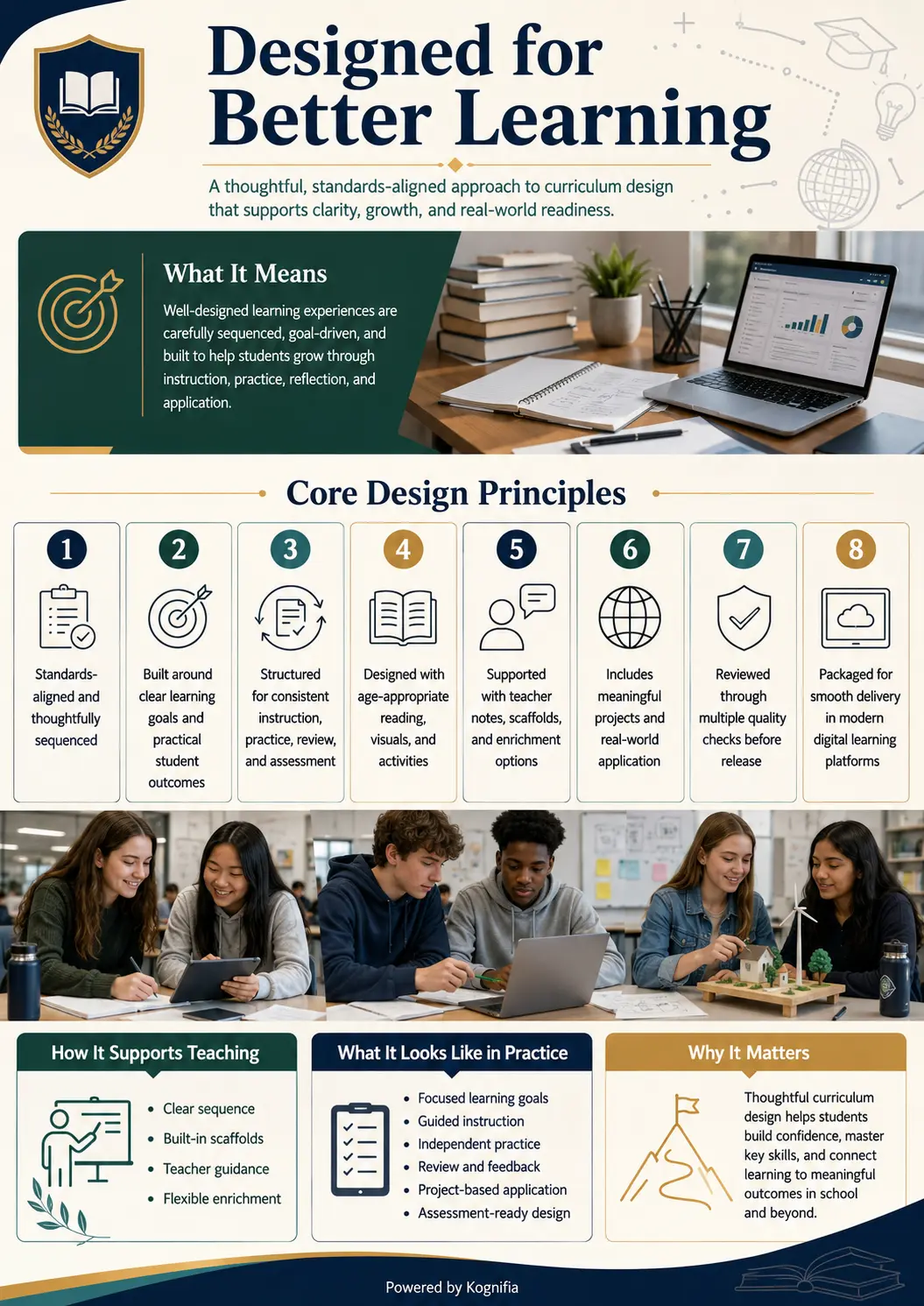
Lessons move from clear explanation into practice, review, and assessment so students are not left guessing.
Course work asks students to connect claims, evidence, models, and feedback instead of only completing tasks.
End-of-unit work gives students a structured way to apply the course ideas in a concrete, reviewable format.
These course samples show how a concept can move from instruction into an applied project with data, explanation, upload expectations, and a rubric.

Next step
Start with a short inquiry so RCA International can route your next step.
Faith resources
Students and families seeking additional faith-centered viewing may explore these external resources. They are not required coursework, chapel attendance, admissions requirements, or dual-credit activities.